On-site Insights (Part 2): The 2nd Global Nature Positive Summit
The Second Global Nature Positive Summit was held in Kumamoto City on July 14 and 15, 2026. The event was organized by the Nature Positive Initiative (NPI) and the Japan Committee for the International Union for Conservation of Nature (IUCN-J). Under the theme “Set Sail Together: Be Part of the Nature-Positive Journey,” domestic and international stakeholders gathered to advance discussions on achieving a nature-positive future. This report summarizes two panel discussions held on the first day: “The Role of Finance” and “Nature-Positive Strategies.”
Overview of the Summit and the First Day’s Focus
The summit brought together stakeholders to discuss practical approaches to nature positive, framed by the Kunming-Montreal Global Biodiversity Framework (KMGBF) and its global goal of “halting and reversing nature loss by 2030.” Prior to the event, media outlets had suggested that the final version of the State of Nature Metrics (SoN metrics) might be released on July 15. This expectation set the context the first day’s discussions, which centered on how to measure the state of nature and how those measurements should be integrated into existing disclosure and evaluation frameworks. NPI provided an update on the development of the SoN metrics, but the final version was not released at this summit.
What Are the SoN Metrics?
The SoN metrics, developed through an international process, are designed to enable companies and financial institutions to evaluate ecosystems and the state of nature using a common scale. They are intended to be integrated into major existing frameworks—such as TNFD, ISSB, GRI, and SBTN—and to function as a “shared language” for companies and financial actors working with natural capital.
“The Role of Finance”: Financialization of Nature-Related Risks
The first session, “The Role of Finance,” brought together representatives from diverse fields, including finance, insurance, paper manufacturing, international standard-setting bodies, and government. Speakers included the head of the insurance division at the United Nations Environment Programme (UNEP), the chief sustainability officer of Dai-ichi Life, the CEO of Oji Holdings, a board member of the International Sustainability Standards Board (ISSB), and a special advisor from the California Department of Insurance. They discussed how nature-related risks are beginning to affect the core of financial decision-making.
The discussion highlighted that in regions experiencing severe nature degradation, underwriting insurance is becoming increasingly difficult, which in turn may influence investment decisions. Changes in nature—such as wildfires, water scarcity, and ecosystem decline—can disrupt business operations and lead to shutdowns or supply chain interruptions. Because of these risks, financial institutions are being called upon to move beyond superficial ESG assessments and conduct deeper analyses of actual business conditions.
“Nature Positive Strategies”: Running Businesses While Measuring Nature
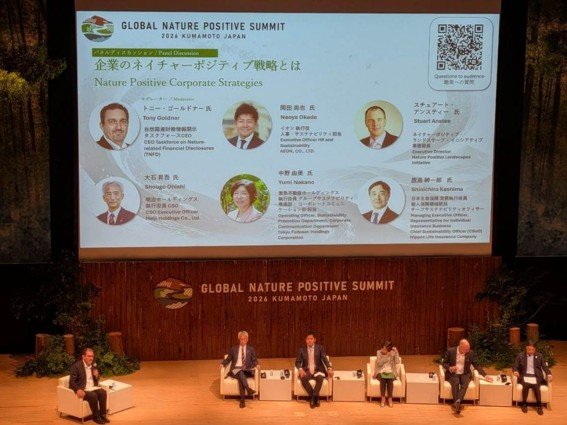
The second session, “Nature Positive Strategies,” featured representatives from retail, food, insurance, and real estate companies, along with a representative from an international initiative. Speakers included representatives from AEON, Meiji Holdings, Nippon Life, Tokyu Fudosan Holdings, and the Nature Positive Landscapes Initiative. They discussed how companies can integrate nature positive into their business strategies.
The speakers noted that industries differ in how they depend on natural capital. Building on a shared set of indicators, companies must develop metrics tailored to their specific business characteristics to measure the state of nature. From the speakers’ remarks, it was clear that companies are beginning to treat nature as something that must be measured—not only for commitments and target setting, but also for verifying and explaining the results of their actions. Nature positive is increasingly viewed not as a slogan or policy statement, but as a challenge that requires rethinking how businesses are operated.
EnviX’s Comment
Across the two panels on the first day, a common theme emerged: companies and financial institutions must evaluate the state of nature using shared metrics and incorporate the results into business strategies and investment decisions. Nature-related risks are already affecting financial performance and insurance underwriting, and companies are expected to establish indicators that define what they need to measure in order to understand and continuously assess their dependencies and impacts.
The SoN metrics are designed as a shared set of measurement standards that enable companies and financial institutions to evaluate nature using the same scale. The first day’s discussions centered on measuring nature through this common scale. Taken together, these developments indicate that the transition toward nature positive is moving beyond the stage of broad principles and is being integrated into business and financial practice through evaluation, management, and disclosure.
The full schedule of the 2nd Global Nature Positive Summit can be viewed at the link below:
https://events.nikkeibp.co.jp/event/2026/GNPS_jp/