On-site Insights (Part 1): The 2nd Global Nature Positive Summit
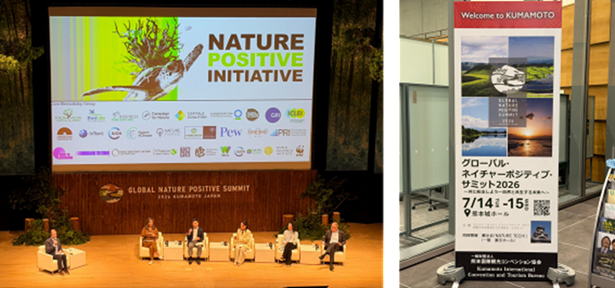
The Second Global Nature Positive Summit was held in Kumamoto City over two days, July 14 and 15, 2026. Organized by the Nature Positive Initiative and the Japan Committee for the International Union for Conservation of Nature (IUCN-J), the summit convened stakeholders from around the world under the theme “Set Sail Together: Be Part of the Nature-Positive Journey.” The event featured a wide range of panel discussions and presentations exploring nature positivity from multiple angles. A key highlight was the adoption and announcement of the Kumamoto Declaration, aimed at accelerating collective action toward nature positivity. Although the final version of the State of Nature Metrics, expected as a unified indicator for measuring natural capital, had been anticipated, it was not formally released at the event.
Staff members from EnviX attended the summit in person, participating in the main sessions and various side sessions to gather the latest global information on biodiversity.
Event Overview
The summit was held at Kumamoto Castle Hall in Kumamoto Prefecture and Kumamoto City, with the aim of advancing the goals of the Kunming–Montreal Global Biodiversity Framework (GBF). Major discussion themes at the main venue included:
- What nature positivity means
- The social and economic significance of nature positivity
- The role of business in achieving nature positivity
- Corporate strategies for nature positivity
- How to measure nature positivity
- Interoperability among standards, metrics, and guidance frameworks
- Technology and innovation for nature positivity
- Nature-positive infrastructure in landscapes and seascapes
The first day focused on the societal relevance of nature positivity and the role and strategies of companies. The second day addressed more practical topics, including measurement approaches, relevant technologies, and corporate disclosure.
The full schedule of the Second Global Nature Positive Summit is available at:
https://events.nikkeibp.co.jp/event/2026/GNPS_jp/
What Is Nature Positive?
Nature Positive aims to halt biodiversity loss and place nature on a measurable path to recovery. Today, biodiversity remains in a negative state, with species extinction occurring at 10 to 100 times the average rate of the past ten million years. The concept of nature positivity calls for improvements not only in environmental conservation but across economic, social, political, and technological domains, with the aim of shifting nature toward a positive state. The concept has gained international recognition, appearing in discussions at COP15 of the Convention on Biological Diversity in December 2022 and in the G7 2030 Nature Compact.
Sources:
- Ministry of the Environment
https://www.env.go.jp/guide/info/ecojin/eye/20240214.html - Ministry of the Environment, Policies for Achieving a Nature-Positive Economy (March 2026)
https://www.env.go.jp/content/000382391.pdf
Kumamoto Declaration
The Kumamoto Declaration sets out the key outcomes of the Global Nature Positive Summit 2026. It explains what the nature-positive goal entails and describes how governments, local authorities, civil society, scientific institutions, and—most notably—the private sector are expected to contribute to achieving it.
- Title: Kumamoto’s Commitment to a Nature-Positive Future (referred to as the Kumamoto Declaration)
- Announced at: Global Nature Positive Summit 2026 (Kumamoto Prefecture)
- Purpose: To present the shift toward a nature-positive economy as an investment and a driver of growth rather than a cost, and to encourage companies and financial institutions to take concrete steps toward achieving the vision of the Kunming–Montreal Global Biodiversity Framework (GBF).
- Signatories: Eighty-five organizations, including private companies, government agencies, NGOs, and research institutions.
List of signatories:
https://www.naturepositive.org/news/other/kumamoto-declaration/
The original text of the Kumamoto Declaration is available at:
https://www.nikkeibp.co.jp/atcl/newsrelease/corp/20260715_2/Kumamoto_Declaration.pdf
Implications for Business
Although the Kumamoto Declaration serves as the event’s concluding document and does not impose binding obligations on companies, its content offers practical guidance for businesses working to advance biodiversity initiatives. One example is its emphasis on applying the mitigation hierarchy—avoid, minimize, restore or rehabilitate, and offset—which is becoming increasingly important in corporate planning and decision-making.
On-site Impressions
The summit was held at Kumamoto Castle Hall, located in the center of Kumamoto City, and attracted approximately 3,000 participants, including guests and speakers. In parallel with the summit, an exhibition titled NATURE TECH! showcased corporate initiatives and services related to nature positivity, including natural capital visualization tools.
EnviX’s Comment
This event was the first international biodiversity-focused conference held in Japan since COP10 in Aichi Prefecture in 2010. A central focus was the development of unified indicators for assessing biodiversity, particularly the State of Nature Metrics. The Nature Positive Initiative shared progress updates but did not release the final version, underscoring the need for continued monitoring.
For companies working to advance nature-positive initiatives, the establishment of comparable, common indicators is expected to accelerate progress. A notable point emphasized during the event was that the development of these indicators places particular importance on practical usability. Among the many existing biodiversity-related metrics, the indicators must not only reflect what is most material for nature positivity but also be feasible for companies and other stakeholders to apply in practice. The details of the State of Nature Metrics currently under discussion will be explained in a separate article.
Another notable theme was the importance of viewing nature-positive initiatives not as costs but as investments in the future. Human society and economic activity rely on biodiversity and natural capital, and continued degradation will ultimately undermine business operations. Treating nature-positive actions as investments is therefore essential for achieving the GBF’s 2030 targets. Yet many companies still find it difficult to adopt this perspective. Firms represented at the event—such as those in beverages, food, housing, and trading—are directly dependent on natural capital, making it easier for them to view nature-positive initiatives as investments. For companies with more indirect exposure, however, large-scale action remains challenging.
During the event, a survey asked, “What is the greatest driver for business to adopt a “Nature Positive” approach?” The most common response was “regulation and legal frameworks.” Some corporate representatives also commented that compliance is a major internal driver for aligning departments around nature-positive initiatives.
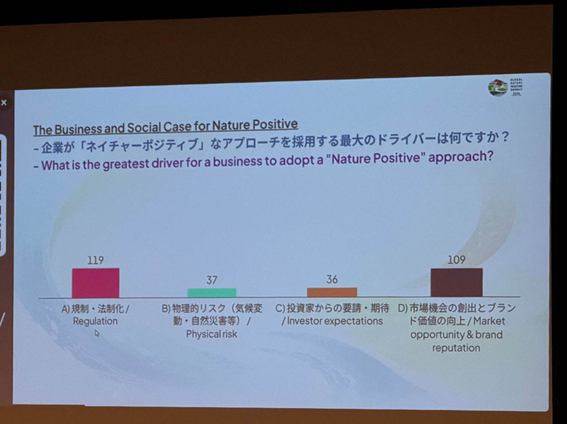
These observations suggest that regulatory development may be necessary to accelerate nature-positive action. In the climate domain, mechanisms such as greenhouse gas reporting, emissions reduction, and emissions trading have become increasingly regulated. Similar approaches may emerge in biodiversity policy. Although such regulations remain limited today, companies should monitor developments closely.
In Japan, the Ministry of the Environment has released numerous strategies, guidelines, and action plans related to biodiversity since the adoption of the GBF in December 2022. Examples include:
- Nature Positive Portal
https://policies.env.go.jp/nature/nature-positive/ - National Biodiversity Strategy 2023–2030
https://www.env.go.jp/nature/biodiversity/initiatives6.html - Nature Positive Economic Transition Strategy
https://www.env.go.jp/page_01353.html - Action Plan for Chemical Management to Promote Nature Positivity (Ver. 1.0)
https://www.env.go.jp/press/press_03786.html - Guideline for Nature-Positive Procurement
https://www.env.go.jp/press/press_05290.html
The Guideline for Nature-Positive Procurement, published on July 14, 2026, summarizes recommended practices for companies across five categories. These practices are highly useful for companies seeking to voluntarily advance nature-positive initiatives:
- Integrating responsible business conduct into corporate policies and management systems
- Identifying and assessing negative impacts across business operations, supply chains, and business relationships
- Ceasing, preventing, and mitigating negative impacts
- Tracking implementation and outcomes
- Disclosing information on responses to impacts