Rooftop Solar Power Generation in the Philippines: Market Growth, Drivers, and Regulatory Developments
Overview of Rooftop Solar PV Systems in the Philippines
The Philippines has significant potential for rooftop solar power generation because of its high solar irradiation and high total building rooftop area. Rooftop solar photovoltaic (PV) systems allow households, businesses, and institutions to generate electricity directly at the point of consumption. Depending on the system configuration, electricity generated by rooftop PV can either be consumed entirely by the owner or, under a net-metering arrangement, excess electricity can be exported to the distribution grid1–4.
The importance of rooftop solar has increased as Philippine consumers face high and rising electricity costs. In May 2026, retail electricity prices in the Meralco service area, the largest private sector electric distribution utility company in the Philippines, were reported to be 17% higher for residential customers, 18% higher for commercial customers, and 14% higher for industrial customers compared with a year earlier. At the same time, solar installation costs declined by approximately 10% over the same period according to reports. These developments significantly shortened the period required for consumers to recover their investment in rooftop solar3,5.
The market has consequently expanded rapidly. Energy think tank Ember estimated that Philippine rooftop solar capacity doubled from early 2025 to early 20263. The expansion is occurring alongside a significant shift in government policy. Recent policy reforms increasingly seek to make rooftop solar adoption and distributed generation easier for individual consumers. An example of this is in April 2026, the Department of Energy (DOE) introduced measures under Executive Order No. 110 to streamline net-metering applications, which establishes guidelines for easing the administrative burden of consumers6.
These developments have positioned rooftop solar as an increasingly relevant component of the Philippine electricity sector. Understanding the extent and characteristics of its current deployment is therefore essential to assessing its potential contribution to the country’s broader energy transition.
Current Situation of the Philippine Rooftop Solar Power
Rooftop solar has developed into an increasingly important component of electricity generation in the Philippines. Although the country does not yet have a comprehensive official inventory covering all rooftop PV installations, recent market estimates indicate rapid expansion. Ember estimated that approximately 600 MW of rooftop solar capacity was added between April 2025 and April 2026, bringing estimated total rooftop solar capacity to around 1.3 GW by early 2026, compared with approximately 721 MW at the beginning of 20253. Despite this growth, the installed rooftop solar capacity represents only a fraction of the Philippines’ estimated rooftop solar potential. The Institute for Climate and Sustainable Cities (ICSC) estimated through satellite data that the country has a theoretical 106 GW rooftop solar potential4. This suggests that a substantial portion of the country’s potential rooftop generation capacity remains undeveloped.
Expansion Across Different Sectors
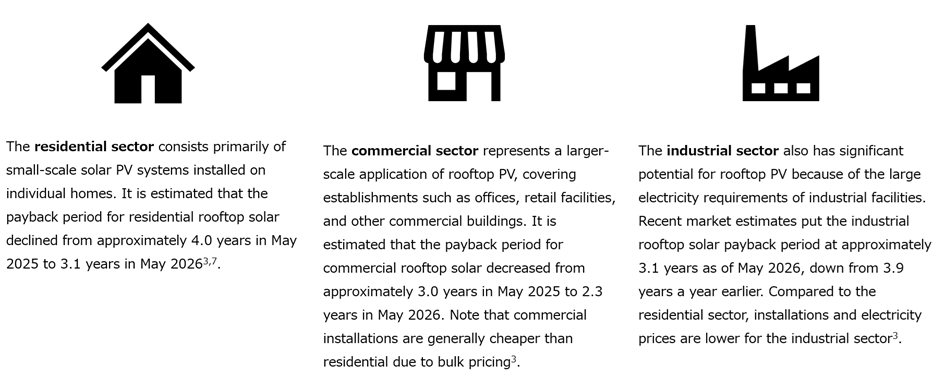
Rooftop solar deployment spans residential, commercial, and industrial sectors, with the scale and economics of installations differing across these segments:
Continued Dependence on Grid-Connected Systems
Despite the growth of rooftop solar, most installations remain closely connected to the existing electricity distribution system. Consumers can use solar generation for their own electricity requirements and, where eligible, participate in the country’s net-metering framework to receive credits for electricity exported to the grid. For smaller installations, the Net-Metering program applies to households and businesses with solar renewable energy facilities with a capacity of less than 100 kilowatts, allowing them to receive credits for electricity exported to the grid. In contrast, the Distributed Energy Resources (DER) program applies to larger businesses with renewable energy facilities exceeding 100 kilowatts but less than 1 MW8.
Furthermore, the scale of participation in formal behind-the-meter programs has also increased. As of June 30, 2026, the Energy Regulatory Commission (ERC) reported 23,684 net-metering prosumers with a combined capacity of approximately 232 MWp, compared to 19,563 qualified end-users and 186 MWp capacity in 2025. The ERC also reported 181 participants in distributed energy resource (DER) programs with a combined capacity of approximately 226 MWp by end of June 20269,10.
Major Growth Drivers of Philippine Rooftop Solar Power
High Electricity Prices
High electricity prices are a major economic incentive for rooftop solar adoption in the Philippines. The Philippines has relatively high electricity prices compared with neighboring Southeast Asian countries. An analysis in March 2026 found that Philippine residential electricity prices were the highest in Southeast Asia, while commercial prices were the second highest and industrial prices the third highest3.
Higher electricity prices improve the economics of self-generation because each kWh of rooftop solar electricity consumed offsets electricity that would otherwise be purchased from the grid. This also means that rooftop solar may become particularly attractive to commercial and industrial consumers with substantial daytime electricity demand. Rather than relying entirely on electricity purchased from the grid, businesses can use solar generation to offset a portion of their electricity purchases.
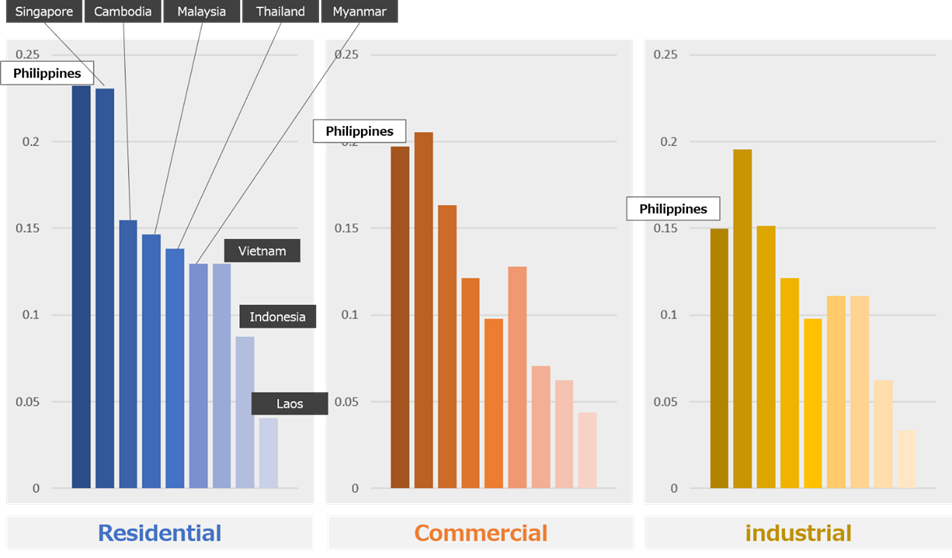
Figure 1. USD/kWh as of March 2026 in Select Countries in Southeast Asia3. PHP to USD conversion rate in March 2026: 1 USD = 59.4069 PHP.
(From left to right: the Philippines, Singapore, Cambodia, Malaysia, Thailand, Myanmar, Vietnam, Indonesia and Laos.)
Source: Bangko Sentral ng Pilipinas/Central Bank of the Philippines: https://www.bsp.gov.ph/statistics/external/tab12_pus_data.aspx
Declining Solar Installation Costs
Falling solar costs have further strengthened the investment case for rooftop PV. Ember estimated that solar installation costs in the Philippines declined by approximately 10% from May 2025 to May 2026, contributing to the shorter payback periods observed across residential, commercial, and industrial sectors3.
The availability of imported PV equipment, mostly from China, has also supported market expansion. Net solar panel imports increased from 3,130 MW in 2024 to 5,068 MW in 2025, while imports reached 4,133 MW in the first four months of 2026 alone. These figures are a huge leap compared to 2022 where the net imports were only 200 MW3. The scale of these imports indicates that equipment availability is no longer as significant a constraint on deployment as it was when rooftop solar was a smaller market.
Corporate Sustainability and Decarbonization
Corporate sustainability objectives are another driver of rooftop solar investment, particularly among large commercial and industrial companies. Rooftop PV can simultaneously reduce electricity expenditure and the emissions associated with electricity consumption, making it relevant to both cost management and corporate decarbonization strategies. There is already evidence of rooftop solar adoption among major Philippine companies. SM Prime reported that its solar installations generated 27.6 GWh of electricity in 2024 and reduced its carbon emissions by more than 19,000 tons of CO₂. The company has linked its continued solar expansion to both energy efficiency and its broader sustainability strategy11. Similarly in 2024, Robinsons Malls reported 29 solar plants across 24 malls with a combined capacity of approximately 31.6 MWp12, highlighting the increasing role of rooftop solar in the commercial property sector.
Notable Current and Proposed Regulatory Frameworks for Rooftop Solar in the Philippines
The regulatory framework for rooftop solar in the Philippines is primarily anchored in Republic Act No. 9513, or the Renewable Energy Act of 2008, which established net-metering for qualified end-users with renewable energy systems. Under the framework, eligible consumers can generate electricity for their own use and receive credits for electricity supplied to the distribution grid. The ERC is responsible for establishing the technical and commercial rules governing interconnection and net-metering13.
The framework has been progressively streamlined to facilitate wider consumer participation. In 2025, through ERC Resolution No. 15, the ERC amended its net-metering rules to introduce measures including the banking and rollover of excess generation credits, transfer of credits in the event of a property ownership change, publication of distribution utilities’ net-metering programs, procedures, and hosting capacities, and making the installation of renewable energy certificate (REC) meters voluntary14.
In 2026, though the DOE-DILG-DPWH Joint Memorandum Circular (JMC) No. 001, further measures reduced documentary and permitting requirements and accelerated the processing of net-metering applications. Local governments were directed to process electrical permits within three working days and Certificates of Final Electrical Inspection within seven working days, while distribution utilities were limited to four documentary requirements. Additionally, a reform through DOE DC2025-10-0020, introduces multi-site and aggregate net metering, enabling energy credits to be shared across multiple accounts within the same distribution utility area. This lets consumers with multiple facilities to use surplus credits generated at one facility to offset electricity costs at another6,15–18.
A significant development came in August 2026, when the DOE issued Department Circular No. DC2026-08-0017, establishing guidelines for Self-Generating Facility Zero-Export Solar Systems (SGF ZESS) and Micro-Solar Systems (MSS) for Own-Use. The rules distinguish systems intended solely for on-site consumption from systems that do not export electricity to the distribution grid19,20. SGF ZESS are classified as connected, which are connected to the distribution system with mechanisms preventing the export of electricity, and isolated, which are not connected to the distribution system. The MSS, on the other hand, are defined as consumer-grade, plug-and-play systems intended for own-use, such as PV Modules with direct current nameplate capacities not more than 1 kW. The following requirements are discussed in the Department Circular19,20:
Table 2. Summary of requirements for Self-Generating Facility Zero-Export Solar Systems (SGF ZESS) and Micro-Solar Systems (MSS) for Own-Use
| Connected SGF ZESS | Isolated SGF ZESS | MSS | |
|---|---|---|---|
| Written notification to the distribution utility | Required | Not required | Required |
| Building permit | Required | Not required | |
| Certificate of Compliance | Required (except for systems for internal use of households, clinics, hospitals, and other medical facilities) | Not required | |
In parallel, House Bill No. 10431, or the proposed Sariling Kuryente Act (Own Electricity Act), seeks to further simplify the regulatory treatment for rooftop solar and battery systems used by households and small businesses. The proposed legislation would exempt qualifying non-exporting, personal-use systems from ERC Certificates of Compliance, restrict additional fees and technical requirements, and prevent homeowners’ associations from prohibiting rooftop solar installations21.
Table 3. Summary of Notable Current and Proposed Regulatory Frameworks for Rooftop Solar in the Philippines
| Policy/regulation | Key provision for rooftop solar | Significance for rooftop solar |
|---|---|---|
| RA 9513 (Renewable Energy Act of 2008)13 | Established net-metering for qualified renewable energy end-users | Provides the legal basis for consumer-owned rooftop solar and export of excess generation |
| ERC Resolution No. 15, Series of 202514 | Introduced banking/rollover of credits, credit transfers, publication of DU procedures and hosting capacities | Improves the economic value and transparency of net metering programs |
| DOE-DILG-DPWH Joint Memorandum Circular (JMC) No. 001, series of 202616,18 and Executive Order no. 1106 | Streamlined permits, reduced documentary requirements, and accelerated application processing | Reduces administrative barriers and processing time |
| DOE DC2026-08-001719,20 | Established rules for zero-export solar and micro-solar systems for own use | Creates simplified requirements for non-exporting rooftop solar systems |
| DOE DC2025-10-002015,17 | Integrates REC trading and multi-site and aggregate net-metering into the existing net-metering framework | Expands market access and potential benefits of distributed renewable energy generation for consumers, particularly those with multiple sites. |
| Proposed Sariling Kuryente Act (HB 10431)21 | Seeks to exempt qualifying personal-use systems from certain regulatory requirements and restrict utility/HOA barriers | Could substantially reduce regulatory barriers if enacted |
Summary and Outlook
Rooftop solar is rapidly becoming an important component of the Philippine electricity sector, driven by high electricity prices, declining installation costs, energy reliability concerns, and growing interest in renewable energy. The improving economics, combined with recent regulatory reforms, are creating more favorable conditions for continued deployment of residential, commercial, and industrial systems. However, realizing the sector’s full potential will require addressing upfront costs, financing, grid integration, imported equipment dependence, and implementation challenges while ensuring affordability and energy reliability. Rooftop solar PVs may be the key to enable Filipino households and businesses to participate more directly in the country’s clean energy transition.
References
- Institute for Climate and Sustainable Cities. A Future Powered from Every Rooftop: Unlocking Rooftop Solar for the Philippines. Institute for Climate and Sustainable Cities https://icsc.ngo/portfolio-items/a-future-powered-from-every-rooftop-unlocking-rooftop-solar-for-the-philippines/ (2026).
- Koons, E. Solar Energy in the Philippines – Current State and Future. Energy Tracker Asia https://energytracker.asia/solar-energy-in-the-philippines/ (2024).
- Jones, D. & Demoral, A. How the Philippines’ rooftop solar surge can flip the energy emergency script. Ember https://ember-energy.org/latest-insights/how-the-philippines-rooftop-solar-surge-can-flip-the-energy-emergency-script/ (2026).
- Institute for Climate and Sustainable Cities. SPECTRUM. Institute for Climate and Sustainable Cities https://icsc.ngo/solar-mapper/ (2025).
- Cordero, T. ‘Payback’ period for residential solar rooftop down to 3 years, says think tank. GMA News https://www.gmanetwork.com/news/money/personalfinance/989315/payback-period-for-residential-solar-rooftop-down-to-3-years-says-think-tank/story/ (2026).
- Naguna, J. L. DOE speeds up net-metering application process to 10 days. Philippine Information Agency https://pia.gov.ph/news/doe-speeds-up-net-metering-application-process-to-10-days/ (2026).
- Varadhan, S., Chai, R. & Portugal, A. Philippines leads the world in rush to solar as power prices soar. Reuters https://www.reuters.com/business/energy/philippines-leads-world-rush-solar-power-prices-soar-2026-06-28/ (2026).
- Lena, P. MORE Power streamlines net-metering, DER processing applications. Philippine News Agency https://www.pna.gov.ph/articles/1238756 (2024).
- Energy Regulatory Commission. ERC Champions Power Sector Reforms, Records Regulatory Milestones in 2025. Energy Regulatory Commission https://www.erc.gov.ph/Press-Singular/84639 (2025).
- Energy Regulatory Commission. ERC Pushes Sweeping and Comprehensive Reforms on Behind the Meter Programs. Energy Regulatory Commission https://www.erc.gov.ph/Press-Singular/85121 (2026).
- SM Prime. SM Prime Scales Up Solar Energy Capacity in 2024. SM Prime https://www.smprime.com/company_releases/sm-prime-scales-up-solar-energy-capacity-in-2024/ (2025).
- Robinsons Land. 2024 Annual Sustainability Report. Robinsons Land https://robinsonsland.com/sites/default/files/2025-05/RLC_2024_ASR_Revised_Report.pdf (2024).
- Congress of the Philippines. Republic Act No. 9513. https://www.officialgazette.gov.ph/2008/12/16/republic-act-no-9513/ (2008).
- Energy Regulatory Commission. ERC Amends Net-Metering Rules to Expand Renewable Energy Opportunities for Filipinos. Energy Regulatory Commission https://www.erc.gov.ph/Press-Singular/84441 (2025).
- Naguna, J. L. PH accelerates solar net-metering with faster permits, new perks. Philippine Information Agency https://pia.gov.ph/news/ph-accelerates-solar-net-metering-with-faster-permits-new-perks/ (2026).
- Caliwan, C. L. DILG to LGUs: Streamline net-metering application process. Philippine News Agency https://www.pna.gov.ph/articles/1267797 (2026).
- Department of Energy. Department Circular No. DC2025-10-0020. https://doe.gov.ph/circular-no-dc-2025-10-0020 (2025).
- DOE-DILG-DPWH. Streamlined requirements and processing of permits, licenses, and/or certifications for Net-Metering applications. https://www.dilg.gov.ph/issuances/jc/Streamlined-requirements-and-processing-of-permits-licenses-andor-certifications-for-Net-Metering-applications/223 (2026).
- Lectura, L. DOE simplifies rules for own-use solar panel installation. BusinessMirror https://businessmirror.com.ph/2026/08/05/doe-simplifies-rules-for-own-use-solar-panel-installation/ (2026).
- Department of Energy. Department Circular No. DC2026-08-0017. Department of Energy https://doe.gov.ph/circular-no-dc-2026-08-0017 (2026).
- Naguna, J. L. Proposed Sariling Kuryente Act seeks to free Filipino households from solar regulatory hurdles. Philippine Information Agency https://pia.gov.ph/news/proposed-sariling-kuryente-act-seeks-to-free-filipino-households-from-solar-regulatory-hurdles/ (2026).