The Crisis of Transboundary Pollution: Environmental Security and Thailand’s Strategic Challenges
Understanding Transboundary Pollution and Its Impacts on Thailand
In the era of rapid economic integration, environmental challenges have increasingly transcended national borders and have become one of the most significant non-traditional security threats in Southeast Asia. Transboundary pollution refers to mass or energy released into the environment by human activities in one country that is transported by natural factors—such as wind or water currents—and causes damage to the health, ecosystems, or economy of another. For Thailand, this phenomenon represents a regional “market failure,” in which the environmental costs of production in neighboring states are externalized onto the Thai population without adequate compensation mechanisms.
This issue directly affects Thailand’s public health and economic stability. Fine particulate matter (PM2.5) has become an annual crisis, with 99.9% of the Southeast Asian population living in regions where levels exceed World Health Organization guidelines. This exposure contributes to severe respiratory diseases and lung cancer.Water resources are also being degraded by heavy metal contamination from upstream industrial activities, threatening food security and the traditional livelihoods of riverside communities. These impacts undermine Thai citizens’ fundamental rights to clean air and water and create long-term socio-economic burdens for the state.
Transboundary Water Pollution: Crisis in Major River Basins
Thailand is currently facing a contamination crisis in several international river basins, primarily driven by unregulated extractive industries outside its jurisdiction.
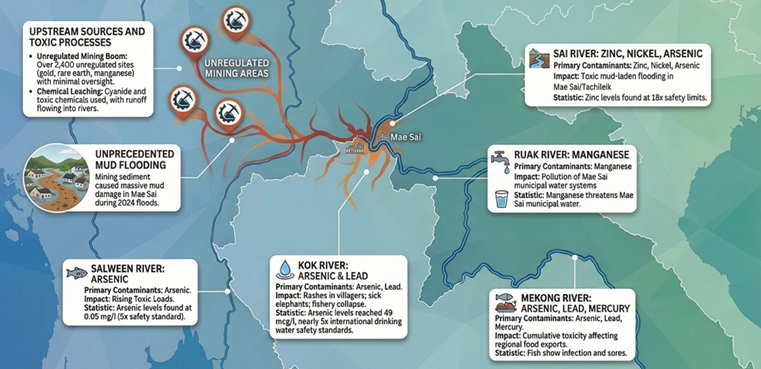
Fig. Transboundary mining pollution
- The Kok, Sai, and Ruak Rivers (Chiang Mai and Chiang Rai provinces):
Scientific testing has confirmed elevated levels of arsenic and other heavy metals in these rivers, originating from the Thai-Myanmar border. The source has been identified as large-scale rare earth and gold mining operations in Shan State, Myanmar, often involving Chinese capital and local forces such as the United Wa State Army (UWSA). Beyond chemical toxicity, these mines caused severe mud-laden flooding in Mae Sai in late 2024, leaving thick residues that were costly to remove and damaging to local infrastructure. - The Mekong River:
The Mekong River system is under severe pressure from the construction of large hydropower dams in the upper basin, particularly in China. These dams act as “pollution traps,” accumulating toxic sediments and heavy metals in reservoirs and increasing the risk that parts of the river could become “toxic reservoirs” that contaminate the food chain. Industrial accidents—such as the 30-ton sulfuric acid spill in Luang Prabang in 2024—also demonstrate how water quality emergencies can quickly escalate into regional political crises. - The Salween River:
Recent scientific investigations in Mae Sariang, Mae Hong Son province, found arsenic levels in the Salween River to be five times higher than safety standards. Experts link this contamination to the rapid expansion of unregulated mining and rare earth extraction near the river’s headwaters in Myanmar.
Transboundary Air Pollution and the Hotspot Crisis
Air pollution, specifically PM2.5 haze, has become a seasonal cycle in Thailand and is heavily influenced by monsoon winds and cross-border agricultural activities. Between December and April, Northern and Central Thailand are severely affected by smoke from the burning of agricultural residues in Myanmar, Laos, and Cambodia.
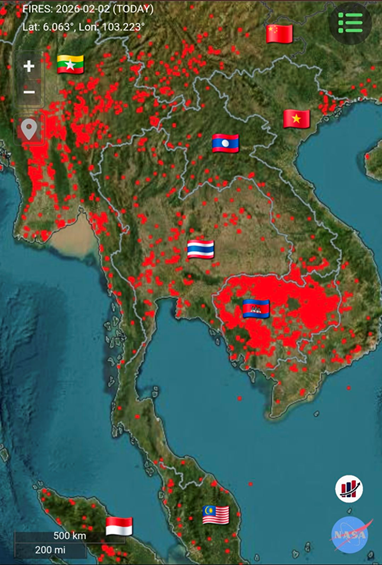
Fig. Satellite imagery provided by NASA shows hotspots in and around Thailand on February 2nd, 2026
Satellite data has revealed a direct correlation between Thai air quality and the number of hotspots (fire points) in neighboring countries. In early 2026, Myanmar recorded over 5,700 hotspots, while Laos recorded over 600, significantly contributing to PM2.5 levels in Thai border provinces. The root cause of this burning is deeply tied to the political economy of contract farming, where multinational animal feed corporations encourage monocrop corn cultivation in high-altitude terrain. In these areas, where machinery cannot reach, burning remains the only low-cost method for land preparation. This haze not only causes thousands of deaths annually but also severely impacts Thailand’s tourism sector, with potential economic losses reaching billions of baht during peak crisis months.
Response Measures and International Comparisons
Thailand has attempted to address these crises through various mechanisms, though it continues to face significant legal and diplomatic hurdles.
- Thailand’s Measures:
The government has elevated PM2.5 management to a National Agenda and is drafting the Clean Air Act, which seeks to regulate pollution sources outside Thai territory. Thailand also initiated the “CLEAR Sky Strategy” (2024-2030) with Laos and Myanmar to reduce hotspots and has signed a 5-year MOU with Cambodia for environmental cooperation. - International Examples:
- Singapore: In 2014, Singapore enacted the Transboundary Haze Pollution Act (THPA), which provides legal authority to hold entities—corporations or individuals—civilly and criminally liable for causing haze in Singapore, even if the burning occurs outside its borders. Fines can reach up to 2 million Singapore dollars.
- The USA and Canada: The historic Trail Smelter Case (1938) established the “No Harm” principle, asserting that no state has the right to use its territory in a manner that causes damage to another state through fumes or pollution. This case laid the foundation for the “Polluter Pays Principle” (PPP).
- Comparison and Leadership:
Thailand places a significantly higher priority on environmental monitoring and public reporting than its immediate neighbors. It utilizes advanced satellite technology via GISTDA and provides real-time air quality data, while neighboring states often lack the transparency, governance capacity, or budget to regulate mining and agricultural activities effectively. However, the “ASEAN Way” of non-interference keeps regional agreements non-binding and limits the enforcement of strict environmental standards.
In conclusion, Thailand must move beyond “defensive” measures such as sediment-trapping weirs and shift toward environmental diplomacy. By leveraging trade mechanisms to enforce sustainability in supply chains and advocating for a legally binding ASEAN Environmental Rights Framework, Thailand can help position clean air and water as collective security priorities for the region.