Assessing the Flood Risk and Mitigation Strategies in the Philippines
Understanding Flood Risk in the Philippines
Geographic and Climatic Factors
Flooding is one of the most frequent and destructive environmental hazards affecting the Philippines. Each year, seasonal monsoon rains and powerful tropical cyclones flood urban centers, rural communities, and coastal areas, resulting in loss of life, damage to infrastructure, and significant economic disruption. As one of the most disaster-prone countries in the world, the Philippines faces an urgent challenge in managing flood risks that are becoming more severe and unpredictable. In 2025 alone, successive storms such as Typhoon Kalmaegi (local name: Tino) and Tropical Storm Fengshen (local name: Ramil) displaced hundreds of thousands of people and caused significant loss of life and property, emphasizing the grave human and economic toll of floods1,2.
The country’s vulnerability reflects its geographic position along the Pacific typhoon belt, where 20 tropical cyclones on average enter the Philippine Area of Responsibility (PAR) each year, with about eight or nine making landfall3. Furthermore, the Philippines’ exposure to flooding is intensified by climate change, rapid urbanization, and environmental degradation. Rising sea levels (about 5-7 mm per year in the Philippines which is roughly double the highest global average rate of 2.8-3.6 mm per year4), stronger typhoons, and changing rainfall patterns increase the likelihood of extreme flood events, while unplanned development and deforestation reduce the capacity of the ground and engineered drainage systems to absorb excess water. Between 60% and 80% of the country’s land area is considered hazard-prone, with about 74% of the population at risk of environmental disasters including floods, reflecting susceptibility across coastal and island communities5. Flooding therefore represents not only an environmental hazard but also a development and governance issue.
Table: Key Climate and Exposure Indicators Related to Flood Risk
| Indicator | Approximate Value |
|---|---|
| Average tropical cyclones per year3 | 20 |
| Cyclones making landfall per year3 | 8-9 |
| Population exposed to natural hazards5 | 74% |
| Sea level rise (mm/year)4 | 5-7 |
The Philippines’ topography also contributes to flood risk. Mountainous areas experience rapid runoff that can cause flash floods in downstream communities, while low-lying floodplains and coastal zones are highly vulnerable to riverine and coastal flooding6.
Human and Developmental Factors
Human activities have significantly amplified flood risk. Rapid urbanization, especially in Metro Manila and other regional growth centers, has led to the conversion of permeable land into impervious concrete and asphalt surfaces, reducing natural drainage and increasing surface runoff. In Metro Manila, built-up areas comprise approximately 85% of the region, and flood-exposed infrastructures have expanded by over 50% between 1985 and 20157. Additionally, excessive extraction of groundwater causes land subsidence, allowing sea levels to rise more quickly and increasing flood risks in coastal areas of Metro Manila8.
Informal settlements often emerge along riverbanks and narrow waterways, placing vulnerable populations directly in high-risk flood zones. Simultaneously, Unauthorized disposal of plastic and all other kinds of wastes from different communities cause clogged waterways, creeks, and drainage systems, due to improper waste management, preventing floodwaters from receding quickly9.
Deforestation and poor land management in upland areas further exacerbate flooding. The loss of forest cover reduces soil stability and water retention, leading to increased surface runoff10. In relation to deforestation, activities such as illegal mining or unregulated quarrying alter the terrain, causing landslides and also increasing surface runoff11.
Lastly, corruption, failed flood infrastructure projects, and poor construction of drainage systems, flood walls, and dams have left many areas and people defenseless against heavy flooding12.
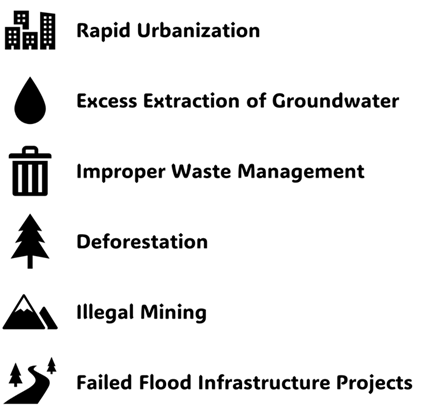
Figure: Human and developmental drivers of flood risk in the Philippines
Current Impacts of Flooding in the Philippines
Human and Social Impacts
Floods impose severe human costs. In 2025, for example, Typhoon Kalmaegi claimed at least 114 lives with hundreds still missing, and displaced more than half a million residents as floodwaters inundated homes across central provinces1. Tropical Storm Fengshen triggered evacuations for more than 22,000 residents and caused additional deaths, highlighting the recurrent nature of flood risk2.
Beyond fatalities, flooding disrupts education, health services, and community cohesion. Evacuation centers often become overcrowded, raising risks of communicable diseases and psychological stress among displaced families13,14. Children, the elderly, and low-income households are particularly vulnerable.
Economic Impacts
The economic toll of flooding is substantial. Floods damage homes, roads, bridges, and public utilities, disrupting transportation and essential services. Agriculture is especially affected, as floods destroy crops and livestock, threatening food security and farmers’ and fishermen’s livelihoods. Repeated flood damage also discourages investment and strains public finances. Climate-related damages and economic losses from 2010 to 2020 across the country amounted to PHP 506.1 billion (about USD 8.6 billion)15.
For instance, Typhoon Gaemi (local name: Carina) and enhanced southwest monsoon rains poured 458 mm of rain in Metro Manila within 24 hours, causing widespread street flooding and significant agricultural damage estimated at PHP 1.17 billion (about USD 19 million)16. Table below exhibits more examples of flood and typhoon events with their associated human and economic impacts. These recurrent climate shocks also disrupt transportation, energy systems, and business continuity, undermining investor confidence and long-term economic planning.
Table: Selected Flood Events and Impacts in the Philippines. Note: As of writing, USD 1 = PHP 58.77.
| Typhoon and Year | People Affected | Economic Losses |
|---|---|---|
| Typhoon Gaemi (local name: Carina) – 202416 | ~4.8 million | PHP 4.26 million damage to infrastructure (~USD 73,000) PHP 1.17 billion damage to agriculture (~USD 19 million) |
| Severe Tropical Storm Wipha (local name: Crising) – 202517,18 | ~105,000 | PHP 500 million damage to infrastructure (~USD 8.5 million) |
| Severe Tropical Storm Bualoi (local name: Opong) – 202519 | 157,849 | PHP 31.4 million damage to infrastructure (~USD 534,000) |
| Typhoon Kalmaegi (local name: Tino) – 202520 | ~1.04 million | PHP 56.21 million damage to infrastructure (~USD 957,000) PHP 46.53 million damage to agriculture (~USD 792,000) |
| Super Typhoon Fung-wong (local name: Uwan) – 202521 | ~7.9 million | PHP 2.7 billion damage to infrastructure (~USD 46 million) PHP 2.2 billion damage to agriculture (~USD 37 million) |
Mitigation Measures in Practice in the Philippines
Structural Measures
Structural flood mitigation measures focus on physical infrastructure designed to control or redirect floodwaters. The Philippine government invests in physical infrastructure to manage floodwaters, which includes22:
- River control dams, dikes, and levees
- Drainage improvements and retention basins
- Pumping stations in low-lying urban areas
- Floodwalls and floodways
While these measures can reduce local flood impacts, poor planning and implementation have undermined effectiveness, as evidenced by reports of delayed or incomplete projects and budget under-utilization12,15,23.
Non-structural Measures
Non-structural approaches aim to reduce vulnerability rather than control water flows. In the Philippines, these include24-27:
- Early warning systems and flood forecasting
- Land use planning and zoning regulations
- Ecosystem-based approaches (e.g., reforestation, mangrove restoration, watershed management, etc.)
- Public awareness campaigns and disaster preparedness training for local government units (LGUs)
Tools like GIS and hazard mapping (e.g., Project NOAH28) are also used in the Philippines, and these tools support evidence-based planning but require updated data to remain effective.
Challenges, Opportunities, and Future Outlook
Key Challenges
Despite significant investments, the Philippines continues to grapple with persistent challenges:
- Budget and implementation gaps and flood control budget utilization has declined. Furthermore, many projects remain incomplete or poorly executed12,15,23,29,30.
- Corruption and accountability concerns have sparked public protests over flood-control project mismanagemen12,15,23.
- Informal settlements in flood-prone areas are difficult to relocate due to socio-economic constraints31.
- Institutional coordination across agencies remains fragmented, weakening integrated flood risk governance32.
Opportunities for Improvement
There are clear opportunities to strengthen Philippines’ flood resiliency:
- Invest in climate-smart infrastructure that incorporates future climate projections into design standards.
- Engage in public-private partnerships to mobilize resources and technical expertise.
- Increase investment in ecosystem-based solutions, such as mangrove and watershed restoration, as these offer cost-effective, multi-benefit mitigation.
- Improve data modernization with updated hazard maps and predictive modeling to enhance preparedness and risk communication.
- Integrate flood risk into national and local development plans, ensuring that infrastructure and land use decisions account for hazard exposure.
- Strengthen enforcement of zoning regulations, discouraging settlements in high-risk zones.
- Boost investment in real-time hazard mapping and early warning systems such as Project NOAH.
- Improve monitoring and accountability mechanisms for flood-control funding and project delivery.
Future Outlook
Flood risk in the Philippines is a complex and growing challenge shaped by environmental hazards, climate change, and human settlement development patterns. While mitigation measures are already in place, significant gaps remain in implementation, governance, and community protection. A comprehensive, data-driven, and multi-stakeholder approach, involving national agencies, local governments, communities, and the private sector, is essential to build true flood resilience.
Effective flood risk management is not just about infrastructure—it’s about empowering communities by integrating climate science into planning and addressing underlying vulnerabilities that make floods a recurring disaster in the lives of millions of Filipinos. By adopting stronger structural, non-structural, and community-based approaches, the Philippines can reduce flood impacts and build a more resilient future for its people.
References
- The Guardian. Philippines declares state of emergency after typhoon Kalmaegi death toll passes 100. The Guardian https://www.theguardian.com/world/2025/nov/06/philippines-state-of-emergency-typhoon-kalmaegi-death-toll (2025).
- AP News. Tropical storm causes 7 deaths in the Philippines. AP News https://apnews.com/article/tropical-storm-fengshen-philippines-vietnam-455a65b89f2727725fa6305a4ab3d9f9 (2025).
- DOST-PAGASA. Tropical Cyclone Information. DOST-PAGASA https://www.pagasa.dost.gov.ph/climate/tropical-cyclone-information.
- Climate Change Commission. Climate Change Projections. Climate Change Commission https://climate.gov.ph/climate-change-projections-our-future-through-the-looking-glass.
- UN Office for Disaster Risk Reduction. Disaster Risk Reduction in the Philippines. https://www.unisdr.org/files/68265_682308philippinesdrmstatusreport.pdf (2019).
- DOST-PAGASA. Floods. DOST-PAGASA https://www.pagasa.dost.gov.ph/learning-tools/floods#:~:text=Cascading%20Effects&text=Even%20the%20most%20minor%20flooding,in%20industry%2C%20commerce%20and%20trade.
- Dulawan, J. M. T., Imamura, Y., Amaguchi, H. & Ohara, M. Social Drivers of Flood Vulnerability: Understanding Household Perspectives and Persistence of Living in Flood Zones of Metro Manila, Philippines. Water (Basel). 16, 799 (2024).
- Royal HaskoningDHV. Land Subsidence. Royal HaskoningDHV https://northmanilabayfps.ireport.royalhaskoningdhv.com/updated-protection-strategy/root-cause–analysis/land-subsidence.
- Jaque, J. A. & Llenos, Ma. D. V. Informal Settlements Encroachment Along the Major Rivers and Creeks: A Major Obstacle in Addressing Drainage Problem and Flooding in the Central Cluster of Metro Cebu, Philippines. IAHR Document Library https://www.iahr.org/library/infor?pid=2477 (2017).
- Climate Change Commission. Keeping up with deforestations. Climate Change Commission https://climate.gov.ph/news/851 (2024).
- Stanimirova, R., Harris, N., Reytar, K., Wang, K. & Barbanell, M. Mining Is Increasingly Pushing into Critical Rainforests and Protected Areas. World Resources Institute https://www.wri.org/insights/how-mining-impacts-forests (2024).
- Gera, W. Flood-Control Fiasco: A Policy Reckoning for Accountability in the Philippines’ Climate Risk Governance. UP Center for Integrative and Development Studies https://cids.up.edu.ph/flood-control-fiasco-a-policy-reckoning-for-accountability-in-the-philippines/ (2025).
- Villeza, M. E. & Jaymalin, M. DOH warns evacuees vs infectious diseases. The Philippine Star https://www.philstar.com/nation/2025/07/21/2459460/doh-warns-evacuees-vs-infectious-diseases (2025).
- Destinado, M. Cebu evacuees face ‘dirty shelters,’ displaced as classes resume. Rappler https://www.rappler.com/philippines/visayas/typhoon-tino-cebu-evacuees-dirty-shelters-classes-resume/ (2025).
- Greenpeace Philippines. Flood control corruption an obscene plunder of much-needed climate funds–Greenpeace. Greenpeace Philippines https://www.greenpeace.org/philippines/press/68522/flood-control-corruption-an-obscene-plunder-of-much-needed-climate-funds/ (2025).
- Zaldarriaga, J. Flood control. Philippine News Agency https://www.pna.gov.ph/opinion/pieces/916-flood-control (2024).
- Crising leaves trail of floods, damage as it exits PAR. Inquirer https://newsinfo.inquirer.net/2084337/crising-leaves-trail-of-floods-damage-as-it-exits-par (2025).
- Patinio, F. DPWH: Infra damage due to ‘Crising’, ‘habagat’ tops P500M. Philippine News Agency https://www.pna.gov.ph/articles/1254713 (2025).
- Calipay, C. ‘Opong’ initial damage in Masbate placed at P31.4-M. Philippine News Agency https://www.pna.gov.ph/articles/1259807?fbclid=IwY2xjawPm2xlleHRuA2FlbQIxMQBicmlkETFDOUVCbVFudmJnYzd0SE9kc3J0YwZhcHBfaWQQMjIyMDM5MTc4ODIwMDg5MgABHllS-p3NJepu42xw4GeUC53TcSrAMSPvuHBfdBHalABcKdTqi4Ge5h25yVdV_aem_O_LlfKqeJzSiA8FnCmQTew (2025).
- Lena, P. Tino affects over 1M residents, damages 20.8K houses in W. Visayas. Philippine News Agency https://www.pna.gov.ph/articles/1263011 (2025).
- National Disaster Risk Reduction and Management Center. Situational Report No. 24 for the Effects of TC UWAN (2025). https://ndrrmc.gov.ph/wp-content/uploads/2025/11/Situational_Report_No._24_for_the_Effects_of_TC_UWAN_2025.pdf (2025).
- Du, S. What’s a flood control project, anyway? Rappler https://www.rappler.com/newsbreak/iq/what-is-flood-control-project/ (2025).
- Mangaluz, J. Philippines spends billions on flood projects, but disasters keep killing. The Philippine Star https://www.philstar.com/headlines/2025/08/20/2466670/philippines-spends-billions-flood-projects-disasters-keep-killing (2025).
- Climate Change Commission. Adopt nature-based solutions to reduce flood risks – Legarda. Climate Change Commission https://climate.gov.ph/news/397 (2020).
- JV EGIS-INCLAM-KECC. Integrated Flood Resilience and Adaptation 1 (InFRA 1) Project. Department of Public Works and Highways https://r11.emb.gov.ph/wp-content/uploads/2023/06/TLRB-EIS-Exec-Summary.pdf (2023).
- Navotas City Hall. Comprehensive Land Use Plan 2016-2025. Navotas City Hall https://www.navotas.gov.ph/Content/clup/Part%203%20-%20Sectoral%20Profile%20Final.pdf.
- Provincial Disaster Risk Reduction and Management Office. Community-Based Flood Mitigation Management Program (CBFMMP). Provincial Disaster Risk Reduction and Management Office https://pdrrmo.bulacan.gov.ph/programs-and-services/cbfmmp/.
- Project NOAH. Know your Hazards. Project NOAH https://noah.up.edu.ph/.
- Presidential Communications Office. PBBM: Canceled flood control budget for 2026 will be realigned to priority sectors. Presidential Communications Office https://pco.gov.ph/news_releases/pbbm-canceled-flood-control-budget-for-2026-will-be-realigned-to-priority-sectors/ (2025).
- Infrastructure spending slumps in July amid flood control mess. Metrobank https://wealthinsights.metrobank.com.ph/bworldonline/infrastructure-spending-slumps-in-july-amid-flood-control-mess/ (2025).
- Viliran, J. A. Housing Rights and the Urban Poor: The Experiences of Selected Relocates in Rodriguez, Rizal. Philippine Journal of Social Development 8, 21–36 (2016).
- Asian Development Bank. Sector Assessment (Summary): Agriculture, Natural Resources, and Rural Development. Asian Development Bank https://www.adb.org/sites/default/files/linked-documents/51294-001-ssa.pdf.