Overview of India’s New Occupational Safety, Health and Working Conditions (Central) Rules, 2026.
What is India’s New OSH rules 2026?
The existing past 13 labour laws in India offered an unorganized way of compliance and created a lot of fragmentation in the system. Due to these past fragmented laws, there were a lot of multiple overlapping involved. For instance, inconsistent definitions, where varying terms across laws made a problem. There were multiple registrations required and separate licenses for each law. There were uncoordinated inspections, and this resulted in a poor safety culture overall. Hence, to tackle all these problems the central government of India has introduced this new OSH rules to make a strong working and health standards across the nation, simplify things and make overall things uniform and rationalized. This new OSH code consolidates all 13 major laws into one single powerful code. This report highlights the major changes from the past laws in India, and what effect this drastic shift in India’s Occupational Safety standards has on establishments for their compliance requirements.
India had 13 major, existing labour laws named mainly,
- Factories Act, 1948
- Mines Act, 1952
- Dock Workers (Safety, Health and Welfare) Act, 1986
- Building and Other Construction Workers (Regulation of Employment and Conditions of Service) Act, 1996
- Plantations Labour Act, 1951
- Contract Labour (Regulation and Abolition) Act, 1970
- Inter-State Migrant Workmen (Regulation of Employment and Condition of Services) Act, 1979
- Working Journalists and other Newspaper Employees (Conditions of Services and Miscellaneous provision) Act, 1955,
- Working Journalists (Fixation of rates of wages) Act, 1958,
- Motor Transport Workers Act, 1961,
- Sales Promotion Employees (Conditions of Service) Act, 1976,
- Beedi and Cigar Workers (Conditions of Employment) Act, 1966
- Cine Workers and Cinema Theatre Workers Act, 1981
To tackle this fragmentation of the laws, the central government had proposed to unify all these laws into four strong new labour codes. The beginning of this big reformation and these drastic changes in India’s Labour laws began in August 2019 when the first Code on wages received the presidential assent. Then in the following year 2020 the Industrial Relations code, code on Social Security and the OSH code received the presidential assent. It took around five years’ time to bring these all-labor codes into force. The draft central rules for all four codes were published for public consultation on 30 December 2025. And at last, on 8th May 2026 the final central rules were notified for all four codes. It works as a reference data for implementation. But we must keep in mind that in India, implementation works on basis of state government too. While the central government operationalized the codes and notified the final central rules, labour is a concurrent subject. Each state and union territory must separately frame and notify its own respective rules. Implementation remains fragmented. Not every
state has notified the rules for all four new Labour Codes.
| Aug 2019 | Code on Wages receives Presidential assent – the first of the four Codes. |
| Sep 2020 | IR Code, Code on Social Security and OSH Code receive Presidential assent. |
| 21 Nov 2025 | All four Labour Codes brought into force; rule-independent provisions effective. |
| 30 Dec 2025 | Draft Central Rules for all four Codes published for public consultation. |
| 8 May 2026 | Final Central Rules notified for all four Codes – the reference date for implementation. |
The OSH Code Highlights:
1.1 Sectors and establishments covered
The government of India has made efforts to tackle the inconsistency in the previous laws by making many things in a uniform and rationalized manner. One of these definitions is sectors and establishments which are covered. The definitions are more simplified and consistent,
- Factory: Factories employing more than 20 or more workers (using power) and 40 or more workers (not using power)
- Commercial establishments: Any commercial establishment which employs 10 or more workers.
- Standard Businesses: Any place of industry, trade, business, manufacturing, or occupation hiring 10 or more workers.
- Mines and Docks: All are covered irrespective of the workers headcount.
In the past the regulations were factory/mine centric but now there is universal establishment coverage. It also includes the IT/ITeS and new emerging sectors. This means that the safety and health concerns are not only restricted to the factories or mines anymore. Each sector needs to keep their establishment safe from all kinds of hazardous accidents and carry out regular inspections.
The registration of an establishment:
Under this code, A new digital centralized portal named Shram Suvidha Portal has been created. It’s a Centralized web portal created by the Ministry of Labour & Employment.
Purpose of the portal:
- Single point of contact for employers, employees, and enforcement authorities.
- This portal helps handle establishments and their inspection reports.
- Entry by employer, establishment and enforcement agency can be done online.
- To manage labor reports and inspections
Key Feature:
- Labour Identification Number (LIN) assigned to every inspectable unit under any Labour Law.
- Enables data integration across multiple enforcement agencies.
- Employee grievances can be received online, and the employer must settle them and submit proof of clearance
- A Labour Identification Number (LIN) is a unique 10-digit number issued to employers and business establishments in India by the Ministry of Labour and Employment. Under the Occupational Safety, Health and Working Conditions (OSH) Code, it acts as a single master identifier to link all labor law registrations (like EPF and ESI) and simplify compliance.
Registration:
- All employers (those employing one or more employees) are required to register online through the portal using Form I.
- A registration certificate will be automatically issued within 7 days of application.
- Businesses that have already registered are required to update their information within 6 months (by November 8, 2026).
- The issued registration certificate must be always displayed in a conspicuous location on the premises.
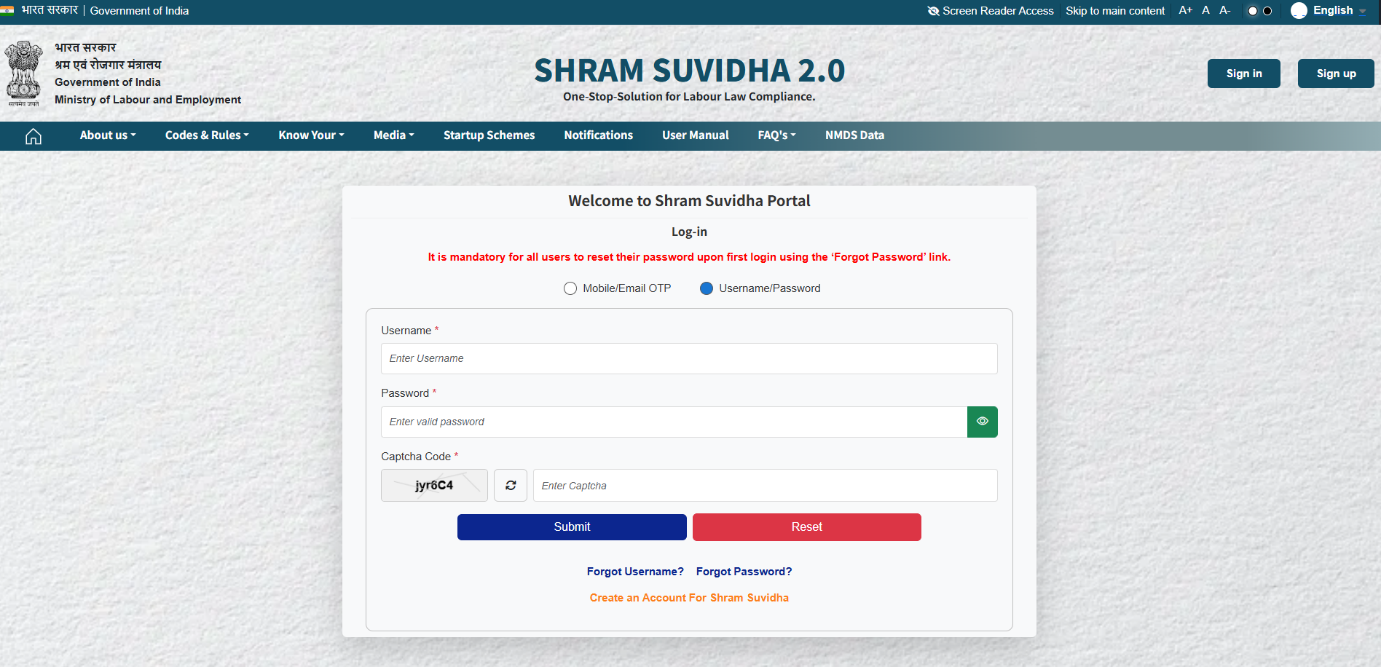 Shram Suvidha Portal 2.0 Homepage
1.2 Accident and dangerous occurrence reporting obligations
- In the event of a fatal accident, a written report must be submitted using Form XI, and the relevant police station and the family of the deceased must be notified electronically and in writing.
- If an employee is unable to work for 48 hours or more due to a workplace accident, the company must notify the employee within 12 hours of the 48-hour period of inability to work having elapsed.
- In the event of a dangerous incident (27 types including gas leaks, explosions, crane collapses, hazardous material spills, and building collapses), notification should be given within 12 hours, even if no injuries occur. All these reports must go to District Magistrate or Sub-divisional Police Officer.
1.3 Mandatory appointment letters and annual health examinations
- The Code mandates that every single employee must receive a formal, written appointment letter (employment notification letter) before they start to work, upon recruitment.
- Employers must provide free annual health checkups for all employees who have completed 40 years of age. The cost will be borne by the employers.
- For industries involving dangerous operations or toxic exposures (e.g., specific factories, mines, and plantations), health examinations are mandatory for all workers, completely irrespective of age.
- The appointment letter must include the workplace’s labor certification number, employment type, job title, start date, wages, and whether social insurance will be applied. If an employee contracts an occupational disease as defined in Appendix 3 of the Code, the employer must immediately report it electronically or by registered mail.
2. Workplace health and environment standards
2.1 Health room and first aid training:
- A first-aid kit should be always kept available during working hours, and the number of kits will be increased in departments with more than 200 employees.
- 33% of all employees will be required to be able to perform first aid and will receive refresher training every three years. If there are female employees, at least one woman will receive training.
- For employers with 500 or more workers, a health room must be established and always staffed with one qualified physician and enough nurses.
- Workplaces employing 500 or more people must establish a safety and health committee. The committee should consist of a maximum of 20 members, with an equal number representing employers and employees, and the appointment of female members should be proportional to the proportion of female workers. The safety committee members must meet at least once a quarter to discuss improvements to occupational safety and health, and employers must implement these improvements within 15 days of receiving recommendations.
2.2 Mandatory signs and facilities:
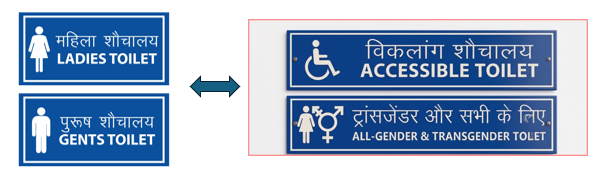
- Separate changing rooms and shower facilities equipped with soap and towels are required for men, women, transgender individuals, and people with disabilities.
- A cafeteria will be established in factories employing 100 or more workers, including contract workers.
- Maintaining cleanliness in workplaces, corridors, and warehouses, installing appropriate drainage systems and non-slip flooring, installing mechanical ventilation if natural ventilation is insufficient, and daily waste collection are mandatory. Safety measures must be taken before entering enclosed spaces. Heat protection equipment must be provided free of charge to those engaged in high-temperature work.
- Each facility must have proper ventilation, drainage, and sanitation, be designed to be lockable from the inside, and have signs at the entrance indicating the target group (e.g., “Men Only”) in Hindi or English, and the local language mandatorily.
- If there are 50 or more female employees, a daycare center (creche) for children under the age of six will be established. This service will be available free of charge to all employees.
- Emergency evacuation drills will be conducted at the factory every quarter. PPE is provided at no cost to employees.
Employers should ensure that:
- Hazardous waste is disposed of safely
- Machinery is inspected regularly
- Workplace accidents are reported on time
- Safety audits are conducted
- Statutory records are maintained and updated
3. Working hours and Role of Inspector-cum-facilitator:
3.1 Working hours
- Working more than 48 hours per week is prohibited in all industries. The code standardizes working conditions by limiting daily hours to eight, capping weekly hours at 48, and mandating a maximum 12-hour spread including overtime.
- The regulations mandate a 30-minute break after five hours of work, require employee consent for overtime, and permit women to work night shifts with adequate safety measures.
- Employees are required to maintain and retain for five years an employee roster (Form XIII), attendance records (Form XIV), and wage and overtime/deduction ledgers (Form XV). All records must be bilingual, in English or Hindi, and the local language. In a prominent location at the workplace, post information such as the company name and address, working hours, payday, incidents that have occurred in the past five years, the name and contact information of the relevant state official.
- Annual reports must be submitted by the end of February each year, in accordance with Forms XVII and XVIII. The reports must include information on employee classifications, health and welfare facilities, dismissals, bonuses, parental leave, and other relevant details.
3.2 Role of Inspector-cum-facilitator
The Inspector-cum-Facilitator is a government senior labor officer appointed by either the Central Government or State Governments under OSH Code, 2020. Government Bureaucrats hold this position.
The Dual Role: Inspector will also hold a role of Facilitator duties (advising, promoting voluntary compliance, providing opportunities to amend errors) against their traditional Inspector legal powers (workplace entry, accident investigation, emergency stops).
3.3 Contract labour and licensing requirements
- The 50-Worker Rule: Ensure you register your establishment if you employ 50 or more contract workers. Core Activities Restriction: Do not deploy contract labor for the core business activities of your establishment, unless it falls under specific temporary or seasonal exceptions.
- Core Activities Restriction: Do not deploy contract labor for the core business activities of your establishment, unless it falls under specific temporary or seasonal exceptions.
- All Mandatory Welfare and Amenities like canteen and adequate restrooms, otherwise the employer will bear the legal responsibility.
- All registrations, contractor license verifications, returns, and compliance filings will be done through online Shram Suvidha Portal.
3.4 Inter-state migrant worker obligations
- This OSH code introduces worker-friendly updates for Inter-State Migrant Workers (ISMW). The code expands the definition of migrant workers to include not just those hired through contractors, but also those who migrate voluntarily on their own to seek employment.
- Migrant workers are entitled to the exact same wages, overtime rates, and working conditions as local workers performing identical roles within the establishment.
- Appointment Letters: Employers must issue formal appointment letters to every worker. Employers must register migrant workers on the central electronic database.
- Accommodation and Health Standards are same as the full-time workers.
Table 1. Comparison of Key Legal Provisions between Old Regimes and OSH Code 2020
| Feature | Old Labour Laws | Occupational Safety, Health and Working Conditions Code, 2020 | Impact |
|---|---|---|---|
| Establishment | Different definitions across laws; largely limited to factories and specific sectors | Uniform definition covering all establishments with >=10 workers, including commercial establishments. | Expands applicability to IT/ITeS and service sector; broader compliance burden |
| Factory | 10+ for manufacturing process with power and 20+ for without power | 20+ for manufacturing process with power and 40+ for without power | Increase in hiring of employees for factories |
| Registration | 13 different registrations under various Acts separately | Electronic registration by the employer of the establishment, 1 single registration. | Ease of registration and conducting business for employer |
| Working Hours | 9 hrs per day, 48 hrs per week | 8-12 hrs per day, 48 hrs per week | Shorter standard workday with consent-based overtime |
| Creche Facilities | Available only when there are 30+ woman workers | Available when there are 50+ total workers employed. | Gender-neutral provision and heavy cost implications |
| Women Night Shifts | No woman shall be allowed to work except between 6 A.M. and 7 P.M. | Women are permitted to work night shifts and in all types of work (including underground mining and heavy machinery), subject to their consent and mandatory safety measures. | Can allow for night shifts with express consent and safety measures. Duty on employers to secure them for flexible staffing. This paves way to Greater employment opportunities for women |
| Feature | Old Labour Laws | Occupational Safety, Health and Working Conditions Code, 2020 | Impact |
|---|---|---|---|
| Health Check-Ups | Limited to hazardous workers only | Employers must provide all workers above the age of 40 years with a free annual health check-up. | Increases costs for medical camps and maintains unified health records. |
| Inter-State Migrant Registration | Employer-registered system | Self-declaration via Aadhaar, portable benefits | Simplified process with benefit portability |
| Journey Allowance for Migrants | Not standardised | Annual journey allowance (not one-time) | Recurring benefit for migrant workers |
| Reporting of Accidents/Diseases | Applicable mainly to factories | All covered establishments | Expands mandatory incident and disease reporting obligations past traditional factories. |
| Penalties | Imprisonment of 2 years or Fine of Rs.1,00,000 or both with further penalty of Rs.1,000 per day for continuous contravention. | Fine of Rs.2,00,000 extendable to Rs.3,00,000 with further penalty of Rs.20,000 per day for continuous contravention. Allows for compounding of offences. | Decriminalised as no imposition of imprisonment but higher fines. |
Outlook of the new OSH code 2020.
Why does Compliance with the OSH code, 2020 matter?
For reduced workplace accidents, Improved employee health and well-being, better legal compliance through digital means the improved OSH code 2020 marks a drastic change in India’s Health and Safety standards.
State wise implementation is still on-going process
- Fully Notified (All 4 Codes): Uttarakhand, Uttar Pradesh, Madhya Pradesh, Karnataka, Bihar, Jharkhand, Odisha, and Himachal Pradesh have finalized all rules
- Three Codes Finalized (1 Pending): Maharashtra, Rajasthan, Haryana, and Punjab have three codes finalized, with the last pending, often in the final draft phase.
- Partial/Draft Stage: States like Andhra Pradesh, Telangana, and Chhattisgarh show partial progress, while Tamil Nadu and Kerala are mostly in the draft stage. West Bengal has experienced significant delays in publishing comprehensive drafts
*Note: There might be a bit of discrepancy in this data as it is a bit from before for some states, few governments may already have notified it by now. Regardless of state-level variations, these regulations have already started to be implemented across India. The 50% Wage Cap Rule (limiting allowances to 50% of total compensation) is active nationwide. The OSH code is expected to be strictly implemented by the end of this year.
References
The original text of these rules can be downloaded from the following URL:
- Occupational Safety, Health and Working Conditions (Central) Rules, 2026
https://egazette.gov.in/writeReadData/2026/272379.pdf