China’s Hazardous Waste Management: Key Policy and Regulatory Updates in 2025
China defines “hazardous waste” as solid waste that is listed in the National Hazardous Waste Catalogue or identified according to national standards and methods, possessing one or more hazardous characteristics such as toxicity, corrosivity, flammability, reactivity, or infectivity, or that may pose harmful effects on the ecological environment or human health and therefore must be managed as hazardous waste.
I. Current Status of Hazardous Waste Generation and Disposal in China
According to the 2024 China Ecological and Environmental Status Bulletin released by the Ministry of Ecology and Environment, the country generated approximately 130 million tons of hazardous waste in 2024, up from 100 million tons in 2023, showing a clear upward trend. The total amount of hazardous waste utilized and disposed of nationwide was about 130 million tons, with a treatment rate close to 100%.
In terms of generation structure, the top five industries caused by hazardous waste output were:
- Manufacture of chemical raw materials and chemical products
- Processing of petroleum, coal, and other fuels
- Non-ferrous metal smelting and rolling
- Ferrous metal smelting and rolling
- Production and supply of electricity and heat
Together, these accounted for 63.3% of the national total.
The top five waste categories were:
- Distillation residues (HW11)
- Waste acids (HW34)
- Non-ferrous metal mining and smelting waste (HW48)
- Incineration residues (HW18)
- Inorganic cyanide waste (HW33)
These categories combined accounted for 63.7% of total generation.
II. Recent Major Policy Developments and Measures
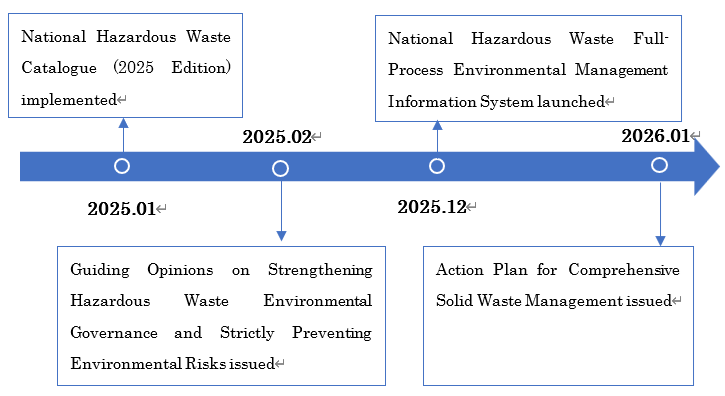
Since the beginning of 2025, there were 4 important policies and regulations issued regarding hazardous waste treatment and disposal.
Guiding Opinions on Strengthening Hazardous Waste Environmental Governance and Strictly Preventing Environmental Risks
In February 2025, the Ministry of Ecology and Environment issued the Guiding Opinions on Strengthening Hazardous Waste Environmental Governance and Strictly Preventing Environmental Risks for hazardous waste treatment and disposal. The main measures include:
- Enhancing collection and disposal capacity: Promote “grid-based” collection for small and micro enterprises, standardized nearby transfer of hazardous waste, and improve a disposal system featuring “provincial matching, inter-provincial coordination, and national planning for special categories.” Improve the dual-use collection and disposal model for medical waste.
- Optimizing utilization and disposal structure: Promote recycling and reuse of hazardous waste, improve standardization of disposal facilities, and strictly control the volume and proportion of landfilling.
- Strengthening environmental management systems: Enforce corporate responsibility, implement the “Five Immediate Actions” for generators—immediate packaging, weighing, coding, and warehousing upon generation—enhance full-process digital supervision, and advance tiered and categorized management.
The Opinions set phased targets:
- By 2026: Full digital supervision coverage for key regulated entities
- By 2027: Basic coverage for relevant entities
- By 2030: Landfilling ratio controlled within 10%, with effective risk prevention.
Implementation of the National Hazardous Waste Catalogue (2025 Edition)
The Catalogue is the core technical directory for identifying and managing hazardous waste in China, serving as a mandatory standard and legal basis for full-process management. The 2025 edition, effective January 2025, revises the 2021 version in line with the Solid Waste Pollution Prevention and Control Law’s requirement for dynamic adjustment.
- Key adjustments
- Integration of codes for pesticide waste adsorbents and chromic acid anodizing waste
- Splitting and adjusting codes for mercury waste under the Minamata Convention and waste ethers
- Addition of four tin smelting wastes, including smelting dust, acid sludge, and arsenic slag
- Improved descriptions for waste paint and residues, added annotations, and refined hazardous characteristics
- New entry HW49-252-05: Microplastic waste (<5mm particle size) designated as key regulated hazardous waste, recommended for high-temperature melting (≥1200°C) treatment
- Refined exemption mechanism:
- New exemption for rural medical waste where centralized disposal is not feasible
- Removal of exemptions for aluminum dross and secondary aluminum recovery
- Clarified that exemptions do not alter hazardous waste attributes and must comply with solid waste regulations, while refining conditions to balance risk control and resource utilization.
National Hazardous Waste Full-Process Environmental Management Information System
Launched December 1, 2025, this digital platform aims to prevent environmental risks, curb illegal transfers, enhance regulatory precision, and reduce compliance burdens. Targets are:
- 2026: Full coverage of key regulated entities
- 2027: Basic coverage nationwide
- 2030: Complete system with landfilling ratio below 10%
Action Plan for Comprehensive Solid Waste Management
The Action Plan for Comprehensive Solid Waste Management was issued by the State Council in January 2026, this five-year guiding policy emphasizes full-chain control of hazardous waste. Key directions include:
- Adhering to reduction, resource utilization, and harmlessness principles
- Standardizing collection and inter-provincial transfer approvals
- Promoting real-time dynamic monitoring and upgrading smart monitoring equipment
- Conducting safety inspections of hazardous waste landfills
- Cracking down on illegal dumping and strengthening enforcement
IV. Development and Outlook
During the 15th Five-Year Plan period (2026–2030), China will focus on addressing gaps in special hazardous waste disposal, improving regional shared facilities, strengthening resource utilization standards, optimizing disposal structure, reducing landfilling, and enhancing “Five Immediate Actions” management. Efforts will include building a unified national information system for full-process supervision, enabling real-time monitoring and traceability.
Hazardous waste management will feature “strict standards, better services, strong supervision, and innovation,” supported by measures such as higher approval authority, improved standards, and targeted exemptions. Enterprises should pay attention to license renewals, exemption changes, and point-to-point utilization applications, plan technology upgrades, and follow requirements for “Zero-Waste City” pilots to improve classification, storage, and disposal processes while mitigating environmental risks.